Children and air pollution

February 25, 2026
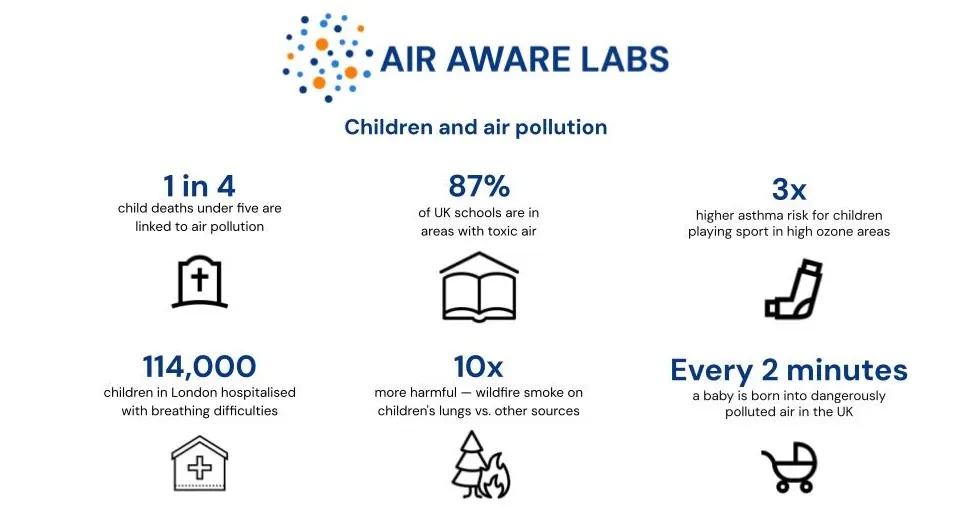
Air pollution is the second leading global risk factor for death among children under five, contributing to nearly one in four deaths of young children in East Asia and the Pacific. In the UK, 87% of schools sit in areas with toxic air, and every two minutes a baby is born into dangerously polluted air. These figures are alarming but air pollution is a modifiable risk. Its drivers lie in transport, energy use, and policy, meaning change is absolutely possible.
Why children face greater risk
Children are uniquely vulnerable. Their lungs are still developing, they breathe faster than adults, and their smaller bodies absorb more pollution relative to their weight. The effects begin before birth. In East Africa alone, an estimated 83,000 newborns died in their first month due to prenatal exposure to fine particulate matter (PM2.5).
Children exposed to high ozone levels at sporting facilities face three times the risk of developing asthma. This is because when children exercise, they breathe faster and more deeply, drawing pollutants further into their lungs at precisely the moment their airways are most open and vulnerable.
Air pollution doesn't just trigger asthma in those already diagnosed. It can cause it in the first place, damaging the developing airways before symptoms ever appear. Research by Whitehouse & Grigg highlights that pollution accelerates airway inflammation in children, with studies showing that exposure to black carbon and traffic-related pollutants causes measurable changes in immune cells lining the airways, changes that prime the lungs for chronic disease.
Sport should be one of the best things a child can do for their health. In polluted environments, it can become a risk. Wildfire smoke compounds this further, being up to ten times more harmful to children's lungs than other pollution sources.
Where exposure happens
Pollution follows children through their daily lives. Choosing quieter back streets over busy roads can cut traffic pollution exposure by a third, yet most children don't have that choice — 87% of UK schools are in toxic air zones, and in London alone, over 114,000 children have been hospitalised with serious breathing difficulties. These are not individual failures. They are the result of how our cities are built and who they are built for.
Clean air improves learning
The damage goes beyond lungs. PM2.5 exposure is linked to anaemia, stunted lung growth, and poorer cognitive development in early childhood, with effects that can follow children well into their teenage years. The good news is that cleaner air visibly improves outcomes. Research from the London School of Economics found that Low Emission Zones boosted Key Stage 2 test scores as much as reducing class sizes or raising teacher quality with the biggest gains in the most disadvantaged schools. Clean air policy is education policy.
A question of justice
The death of Ella Adoo-Kissi-Debrah, the first person in the UK to have air pollution cited as a cause of death, put the human cost of toxic air into sharp relief. Her mother Rosamund, now a prominent campaigner, has helped transform a personal tragedy into a defining moment for clean air advocacy in the UK. Ella's story is a reminder that no child is immune, and that the fight for clean air is a fight for every child.
UNICEF frames clean air as a fundamental child right, and advocates like Mums for Lungs have pushed this into public debate. Legally, ClientEarth has challenged the UK government over unlawful pollution levels, establishing that clean air is not just a public health priority but a legal obligation. This is not simply an environmental metric. It is a question of whose children are protected.
At Air Aware Labs
At Air Aware Labs, we believe clean air is fundamental to healthy childhood development. The evidence is clear: polluted air holds children back — physically, cognitively, and academically. But when air quality improves, so do children's health and life chances. Recognising this as a justice issue, not just an environmental one, is the first step toward solutions that work for every child.
Join us on our mission to personalise air quality, for everyone.
.svg)