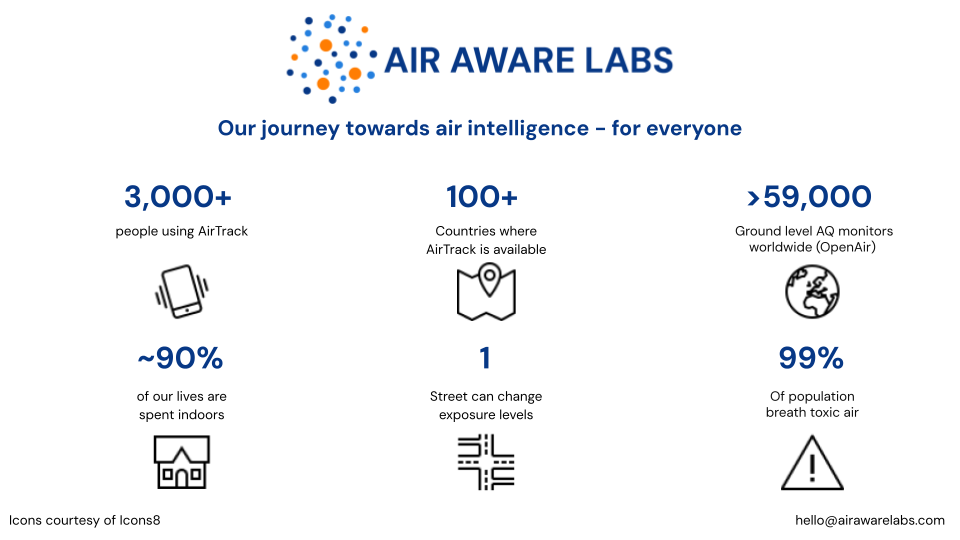
Our journey towards air intelligence, for everyone

February 17, 2026
At Air Aware Labs, our ambition has always been simple: to make personal air pollution risk universally accessible.
We believe that understanding your own exposure should be a fundamental right. Whether it’s choosing a cleaner commute, timing a morning run, or improving ventilation at home, everyone deserves access to the data they need to protect their health.
The decision to build AirTrack as a mobile app was intentional. Smartphones are already everywhere, from London to Cebu. They require no specialist equipment to buy, charge, or remember to carry - and they move with you, reflecting your exposure as it unfolds day by day. By leveraging global datasets, we’ve turned the device already in your hand into a powerful source of environmental intelligence, currently available in over 100 countries.
The challenge: pollution is dynamic
Air pollution shifts from one street to the next, rising and falling hour by hour as traffic patterns change, weather systems move through, and cities breathe in real time. Yet for decades, exposure has often been reduced to a single, average number tied to a home postcode.
In reality, what we breathe depends on how we live. A commute through a subway tunnel tells a very different story from a walk along a quiet side street. A run through a park bears little resemblance to exercising beside a busy road. Even at home, exposure is shaped by how outdoor air flows indoors and how well spaces are ventilated.
Capturing true exposure means moving beyond averages and assumptions. It means recognising lived experience: where people actually go, how long they stay there, and how their daily choices shape the air they breathe.
AirTrack: real data for real lives
So, how are we doing it?
In many regions, AirTrack already delivers highly granular air quality intelligence, providing accurate street-level data updated hourly. This is the level of detail needed to support meaningful advice such as our Cleaner Routes feature.
In areas where public monitoring is sparse, AirTrack could also integrate with portable and wearable sensors to improve granularity and help fill data gaps, without making hardware a prerequisite for insight.
Meanwhile, most of us spend close to 90% of our time indoors. Indoor air quality is shaped by cooking, cleaning, ventilation, and the infiltration of outdoor pollution. AirTrack models indoor exposure using factors such as ambient concentrations, infiltration rates, and known indoor sources and their emission rates. We are also evolving the platform to ingest data from indoor air quality sensors such as AirGradient, helping users understand when opening a window helps, when it doesn’t, and how indoor conditions compare with the outside world. As we recently noted in an expert feature, indoor air quality can be improved, which is why we are also collaborating with air purifiers and smart home systems.
From data to health, at scale
AirTrack exists because air pollution is one of the largest, most unequal health risks of our time, and yet it remains largely invisible at the individual level. By turning complex environmental data into personal, actionable insight, we’re helping people make better decisions today, while generating the evidence needed to improve environments tomorrow.
We are enabling prevention, supporting healthier behaviours, and creating a shared understanding of how the environments we live in shape our health. We are designing our platform to work everywhere, for everyone - whether you live in a data-rich city or a place where monitoring has historically been limited. And as we collaborate with researchers, cities, healthcare partners, and technology providers, we’re building the foundations for a future where environmental health becomes a core part of everyday decision-making.
Join us on our mission to personalise air quality, for everyone.
.svg)