Annual Report 2025

December 17, 2025
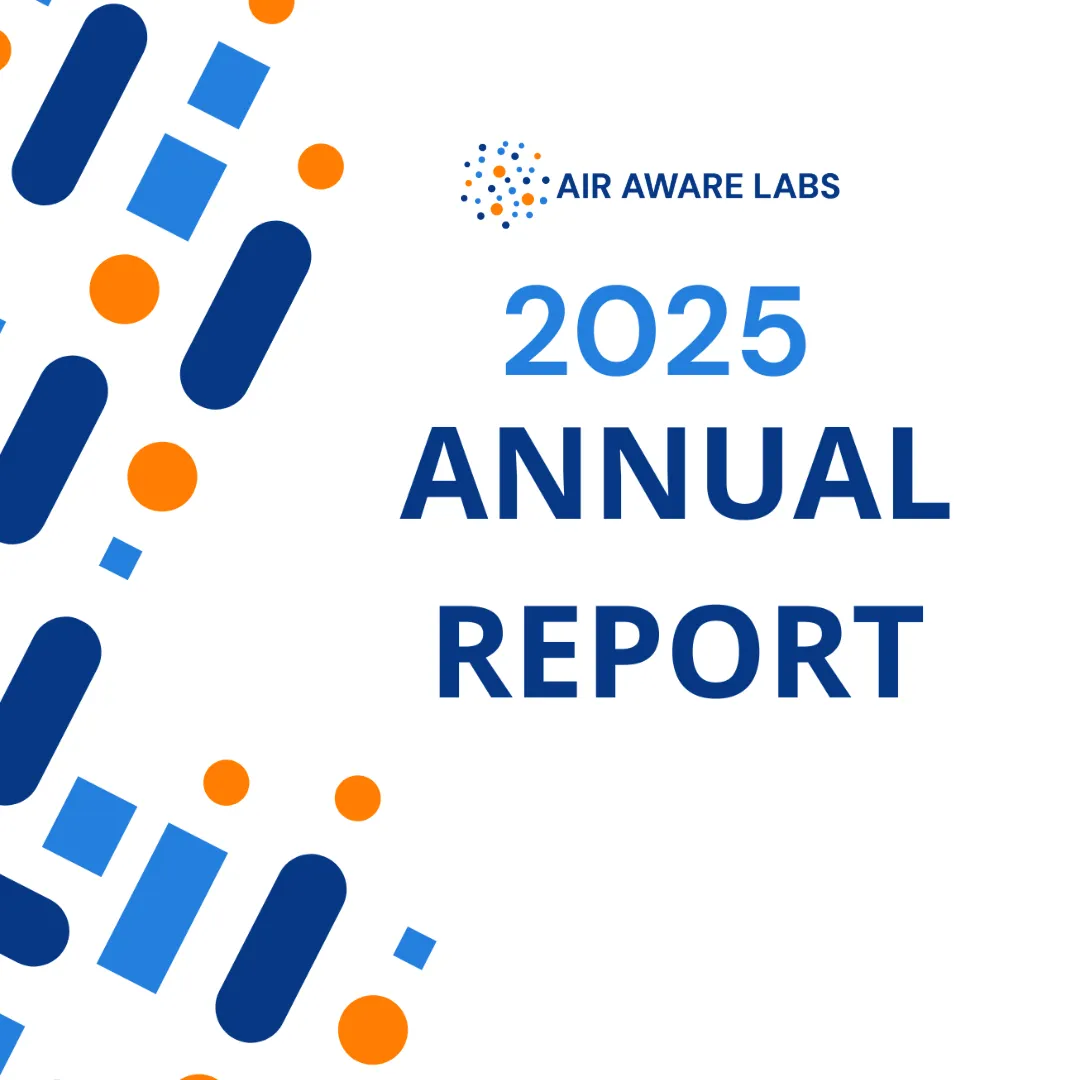
Today, Air Aware Labs has published its first Annual Report (2025), revealing what happens when air pollution is tracked by individuals through AirTrack, the company’s personalised air quality app. Based on more than 250,000 real-world journeys, across daily commutes, workouts and routine activities, the report shows how individual exposure to pollution quietly shapes health, performance and everyday behaviour.
Unlike traditional city-wide averages, AirTrack captures hyper-local, time-specific exposure, reflecting what people actually breathe as they move through streets, transport networks and indoor–outdoor environments..The findings show that pollution exposure is widespread, uneven and often invisible.
The report found that 41% of nitrogen dioxide (NO2) readings and 20% of fine particulate matter (PM2.5) readings exceeded World Health Organisation guidelines. Exposure was driven by both steady background pollution, and also short, intense episodes, influenced by route choice, transport mode and timing.
Beyond exposure levels, the data revealed clear behavioural and physiological signals. When given personalised information, people adapted their routes and routines to reduce exposure. Daily Heart Rate Variability (HRV), a marker linked to recovery and resilience, showed a moderate, statistically significant association with air quality, with cleaner air linked to better recovery.
Together, these insights point to a major opportunity across wearables, insurance, workplace wellbeing and mobility platforms, where personal exposure data can explain variation in health and performance that is often treated as unexplained “noise”.
Louise Thomas, CEO and co-founder of Air Aware Labs, said: “People track almost everything about their health, yet air – the substance we interact with most – is missing. Our first Annual Report shows that when air quality is made personal, people naturally make healthier choices.”
A key learning from 2025 was the importance of communication. The report shows that calm, AI-driven, personalised messaging helped users take practical action more effectively than generic pollution alerts.
Dr Will Hicks, Chief Scientific Officer and co-founder, said: “Air pollution is the greatest environmental health challenge of our time, yet it remains largely invisible at the individual level. Personalised exposure insights are not only measurable and actionable – they are essential for accurate health, performance and mobility modelling.”
The report concludes that personal environmental intelligence is no longer a ‘nice to have’. By combining route optimisation, wearable-linked physiology and scalable API infrastructure, Air Aware Labs is building a foundational environmental intelligence layer for health and mobility systems.
Detailed analyses from the 2025 dataset have been prepared and submitted for peer-reviewed publication.
.svg)