Circular Routes are now live!

March 11, 2026
Here’s the tricky part we had to solve. Ask a pollution-avoiding algorithm for the cleanest route from your front door back to your front door, and its honest answer is: don’t go anywhere. Not much help when there’s a 10k in your training plan.
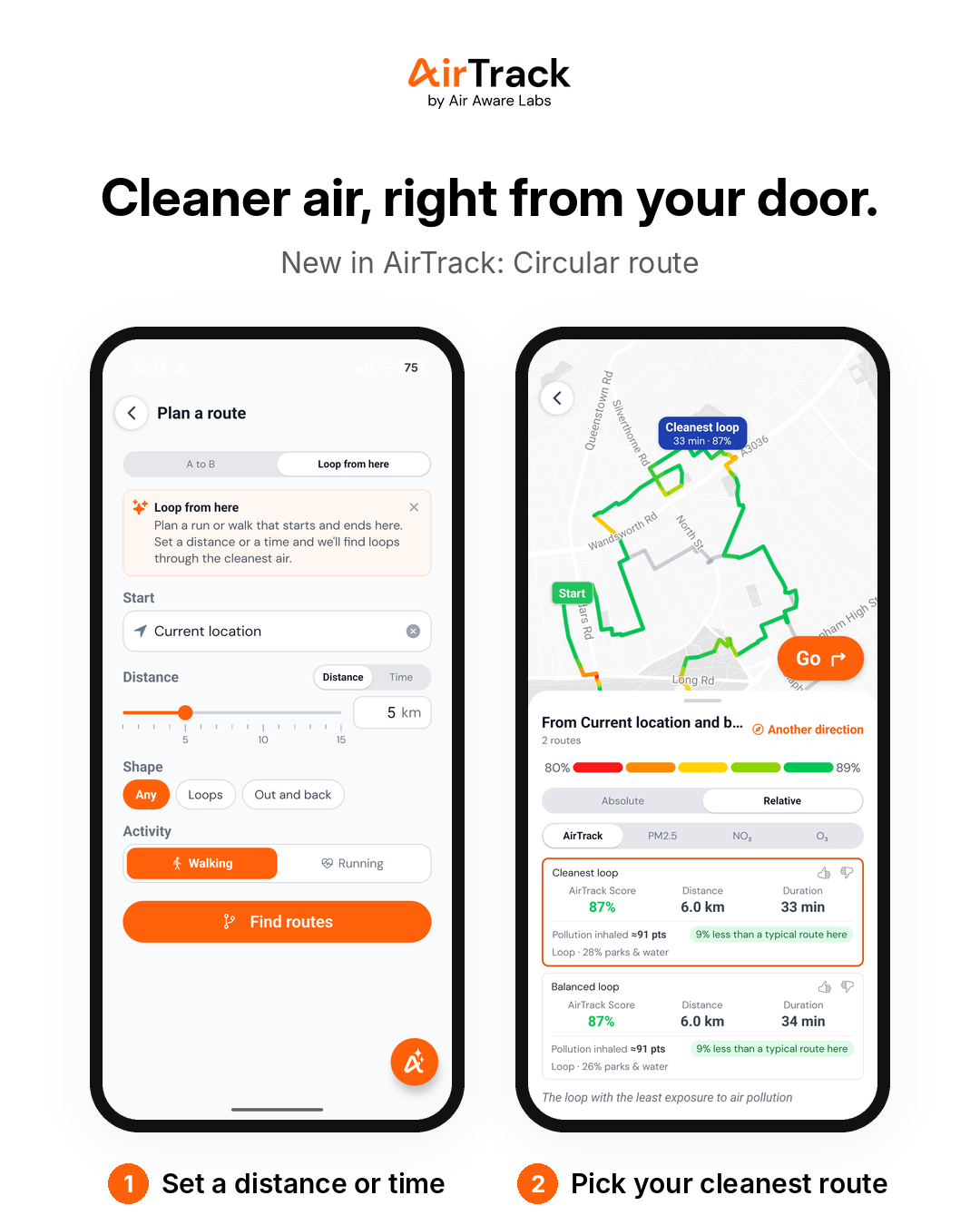
So Circular Routes keeps each route close to the distance or time you asked for, then finds the cleanest way to cover it. You get the session you planned, with less of the bad stuff along the way.
Why it matters when you’re exercising
When you exercise, you’re not just breathing more often, you’re breathing much more air. At rest, most people breathe roughly six to 10 litres of air per minute. During running, that can rise five to six times, which means a session in “moderate” pollution can still add up to a surprisingly large inhaled dose. A 2026 study of outdoor cardio training found the hourly dose of particles reaching the lungs rose 9.5-fold between rest and high-intensity exercise.
It’s not just how much you breathe, but how. During endurance exercise you switch to breathing through your mouth, which bypasses your nose’s natural filter and lets pollutants travel deeper into your lungs. Research on endurance athletes links nitrogen dioxide (NO2) and fine particulate matter (PM2.5) to impaired lung function, airway inflammation and stress on blood vessels, as well as slower race times.
What about your heart? This is where it really counts. Fine particles are small enough to pass from the lungs into the bloodstream. A major review in JAMA found that short-term rises in most common air pollutants were linked to a higher risk of heart attack, and Harvard researchers note that even short-term PM2.5 exposure can trigger one. Pollution can also show up in your recovery. Research links short-term exposure to reduced heart rate variability (HRV), higher atrial fibrillation risk and slower race times, and our own Annual Report found a moderate, statistically significant link between daily HRV and air quality, with cleaner air associated with better recovery.
And where you run matters. Pollution doesn’t spread evenly across a city. Our data shows that a runner on a busy urban road can inhale three to five times more pollution than someone on a nearby backstreet. Green space helps too: a 2026 study of a park in Guildford found morning PM10 levels were 11% lower inside the park than on surrounding streets. That’s exactly what Circular Routes is built to find for you.
None of this is a reason to stop exercising. Just 15 minutes of daily activity cuts the risk of death from any cause by 14%, and in most cities the benefits of being active far outweigh the risks from air pollution. But pollution can blunt some of those benefits. Exercise reduces inflammation in the body, while pollution increases it. Choosing a cleaner route is a simple way to keep more of the good you’re doing.
The science behind your route
Circular Routes runs on the same engine as Plan a Route. AirTrack models air pollution street by street, at 50-metre resolution, updated hourly, and matches it to where you go and how hard you’re breathing. In testing against 145 Breathe London sensors, our model was up to 35% more accurate. So when AirTrack says one loop is cleaner than another, it’s because the air on those streets really is different.
How to find your route
Ready to try it? Here’s how:
- Open Circular Route and choose Loops or Out and back
- Set a distance or a time, and pick walking or running
- Compare your options by AirTrack Score, distance and duration. You’ll also see how much pollution you’d breathe in, how much of the route runs through parks and along water, and how it compares to a typical route from the same spot
- Not feeling it? Tap Another direction for fresh routes heading a different way
- Hit Go and follow your route home
No planning, and no maps open in five tabs. Just step outside and go.
Want to see it in action? Watch our quick tutorial, Get Circular Clean Routes, for a walkthrough from setting your distance to hitting Go.
Take it to your wrist
Found a loop you like? Send it straight to your Garmin and follow it from your watch, with no phone in hand mid-run. We’ve also made syncing with Garmin smoother, so your route arrives on your watch faster and more reliably, ready when you are.
Availability
Circular Routes is part of Plan a Route, a Premium feature. Free users can try it 5 times, and Premium members get unlimited routes on every run and walk.
Update AirTrack today and try Circular Routes on your next run or walk. Then tell us where it took you!