World Car Free Day 2026

September 22, 2026
Sitting in traffic on a weekday morning, windows up and radio on, it's easy to feel you're in a little bubble, sealed off from the fumes outside. It's a nice thought. Unfortunately, it isn't quite how it works.
Today is World Car Free Day, the last day of European Mobility Week. It feels like the right moment to look at what our cars are doing to the air we breathe, and at what happens when there are fewer of them. Most of us only spend a small part of the day getting from A to B. For the average Londoner it's about 6% of their time. But that short stretch can account for up to 30% of the air pollution they breathe in each day.
A world on wheels
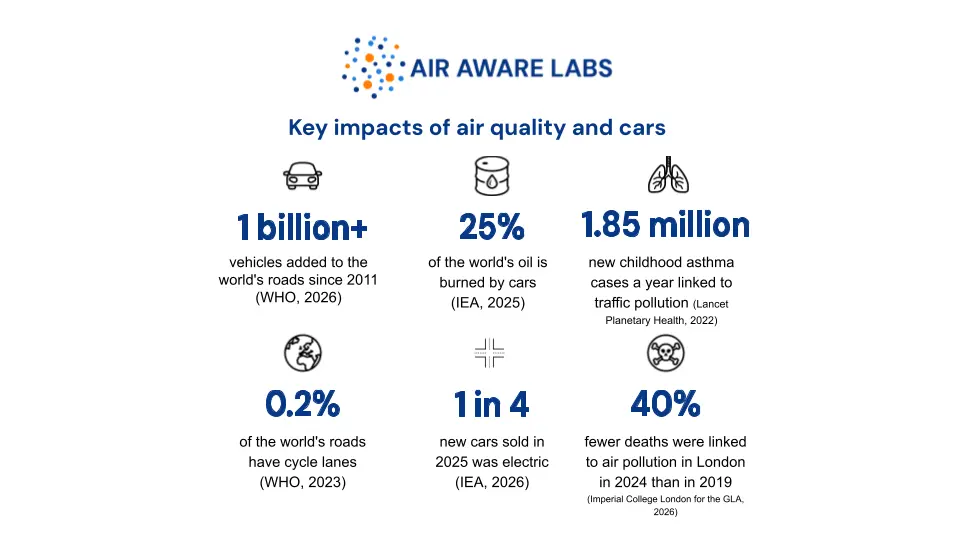
World Car Free Day is a global day, so it's worth zooming out for a moment. The world bought nearly 80 million new cars in 2024, which is more than 200,000 every single day. Between 2011 and 2025, more than one billion motor vehicles were added to the world's roads. And the growth has moved. China and other emerging economies now buy more than half of the world's new cars, up from just a fifth in 2000.
And internal combustion engine cars need fuel. Passenger cars are the single biggest user of oil on the planet, burning through around a quarter of all the oil the world uses. Add in lorries, vans and buses, and road transport accounts for close to half of global oil demand. Burning all that petrol and diesel puts nitrogen dioxide and fine particles into the air we breathe, and warms the planet too.
The good news is that things are starting to shift. More than 20 million electric cars were sold in 2025, one in every four new cars. Sales of cars that run only on petrol or diesel peaked back in 2017. The world's electric cars are already saving around 1.7 million barrels of oil a day. But as we'll see, cleaner cars are only part of the story.
It's a safety question too. Road crashes killed 1.16 million people in 2025, and they're the biggest cause of death for children and young people aged 5 to 29. More than half of the people who die aren't in a car at all. They're walking, cycling or on a motorbike, often on roads that weren't built with them in mind. Just 0.2% of the world's roads have cycle lanes. It's why the World Health Organization is calling for roads that are "designed for people first, not motor vehicles".
The car isn't the bubble we think it is
When traffic is crawling along nose to tail, fumes from the car in front get pulled in through your air vents and can build up inside. That means the air inside a car can sometimes be worse than the air at the roadside.
Traffic lights are the worst of it. Researchers at the University of Surrey found that drivers spend only about 2% of their journey waiting at lights. Yet that short wait makes up around a quarter of their exposure to harmful particles. It's one reason people on foot are exposed to around 40% less fine particle pollution (PM2.5) than people in cars.
It isn't only about the exhaust pipe, either. Brakes, tyres and the road itself all wear away into tiny particles. Back in 2019, the government's Air Quality Expert Group found these non-exhaust emissions already made up 60% of the fine particles coming from UK road traffic. A study published last December found that tyre and road wear are now the biggest sources of particle pollution from traffic.
Electric cars are a real step forward, with no exhaust and brakes that wear down more slowly. But they tend to be heavier, and heavier cars can mean more tyre and road wear. Europe is starting to act on this. From 29 November, the EU's new Euro 7 rules will set the first limits on brake dust from new car models, with tyre wear next in line.
What happens when the cars go
The good news is that air responds quickly when traffic eases off. On Paris's first car-free day back in 2015, nitrogen dioxide (NO2) fell by up to 40% in parts of the city. Over the past twenty years, as Paris has cut traffic and built cycle lanes, its air pollution has roughly halved.
London has been running its own experiment since April 2019, when it launched the world's first 24-hour Ultra Low Emission Zone (ULEZ) in the centre of the city. The zone grew to cover inner London in 2021 and the whole capital in 2023, and the results are hard to ignore. Since 2019, NO2 levels have fallen by 41% and fine particle pollution by 28%. In 2024, London met the legal limits for NO2 for the first time.
Cleaner air is already saving lives. New analysis by Imperial College London estimates that deaths linked to air pollution in the capital fell by around 40% between 2019 and 2024.
Hospitals are feeling it too. A study published this summer looked at adults living in central London after the T-charge and then the ULEZ came in. Their emergency admissions for heart problems fell by around 9% a year compared with a similar part of London outside the zone.
Children's lungs are catching up
For us, the most hopeful finding came out just last month, and it's about children. Traffic pollution is especially hard on growing lungs. Worldwide, it's linked to nearly two million new cases of childhood asthma every year. If you're a parent doing the school run, this is the part worth reading twice.
The CHILL study, from researchers at Queen Mary University of London, Imperial College London and the University of Oxford, followed more than 3,400 children aged six to nine. They came from 84 primary schools in central London and in Luton, which has no clean air zone. The children had their lungs tested every year, starting just before the ULEZ arrived.
At the start, London children could breathe out 38 ml less air in one second than children in Luton, a standard measure of lung health. Over the next four years, NO₂ fell faster in London, and London children's lung function grew by an extra 10 ml a year. By the end, the gap had closed completely. The share of London children with clinically impaired lung function fell from 14% to 9%, a bigger drop than in Luton.
The study was published in The Lancet Public Health. The researchers say it suggests the earlier gap in children's lung development was restored, and that it supports rolling out clean air zones more widely.
Walking and cycling: breathing harder, but breathing better
So is it better to leave the car and walk or cycle? Mostly yes, with one catch. When you're pedalling hard or walking briskly, you take in a lot more air. One Belgian study found cyclists breathed in 4.3 times more air than car passengers. New research this year found that counting how hard people breathe changes the picture for up to half of city cyclists.
The big difference is that you're not stuck behind someone else's exhaust, and you get to choose your way. That choice counts for a lot, because pavements next to busy roads can have 1.5 to 7 times more pollution than quieter streets nearby.
The bigger picture is reassuring too. A Cambridge-led study found that in the vast majority of the world's cities, the health benefits of walking and cycling outweigh the harm from air pollution.
Small swaps for today, and every day after
If you'd like to mark Car Free Day, the easiest place to start is leaving the car at home for one journey. Walk to school, cycle to work or take the bus for part of the way. Every car that stays on the drive means fewer fumes for everyone else on the street, and cleaner air makes a real difference to children's lungs.
After that, take a look at your route. A back street that runs alongside the main road, or a path through the park, might add a few minutes. But it can make a real difference to what you breathe. Travelling a little before or after the rush hour helps too.
And if you do need to drive, you can still look after the air inside your car. In queues and at red lights, keep the windows up, switch the fan off or onto recirculate, and leave a little more space to the car in front. When you park, switch the engine off, especially outside schools.
See the difference with AirTrack
When we first wrote about air pollution and commuting in 2024, AirTrack was only a few months old. Now it gives every run, ride, walk or commute an AirTrack Score for its exact route and time. It shows you the pollutants and pollen behind that score, and suggests cleaner routes and better times for next time.
It connects with Strava, Apple Health and Google Health Connect. As of this month it works with Garmin too, so Premium users can send a cleaner route straight to their watch.
London has shown what cleaner streets can do for a whole city. So why not see what a car free day does for you? Log your journey today, try a cleaner route next week and see the difference for yourself. All through September, AirTrack Premium is £1.99 a month for the first year.
Get Premium: https://airawarelabs.app/icad2026
See what you breathe. Choose where you move.
.svg)