Air pollution and sleep: what the research tells us

From a night of coughing to the depth of your sleep, here's what the research says about the air we breathe, by day and by night.
You can't see the air you breathe, and you certainly don't notice it at 3am. But you spend around a third of every day asleep, during the hours when your body does much of its repair work. So it's worth knowing how the air around you, indoors and out, might be affecting those hours.
Most air pollution research looks at what happens while we're up and about: on the commute, in the park, out for a run. Sleep has had far less attention. That's starting to change, and one of the most striking studies yet landed in September. It used something most of us keep by the bed, a phone, to show that the air we breathe during the day, outdoors included, can follow us into the night.
A night of coughing, counted by phone
Researchers at the University of Cambridge, Tsinghua University and the sleep app company Sleep Cycle used the app's microphone to count coughs overnight. The anonymised data covered 32 cities in 12 countries over 500 days, pooled by city, and the team allowed for other things that make us cough, such as the weather and flu levels.
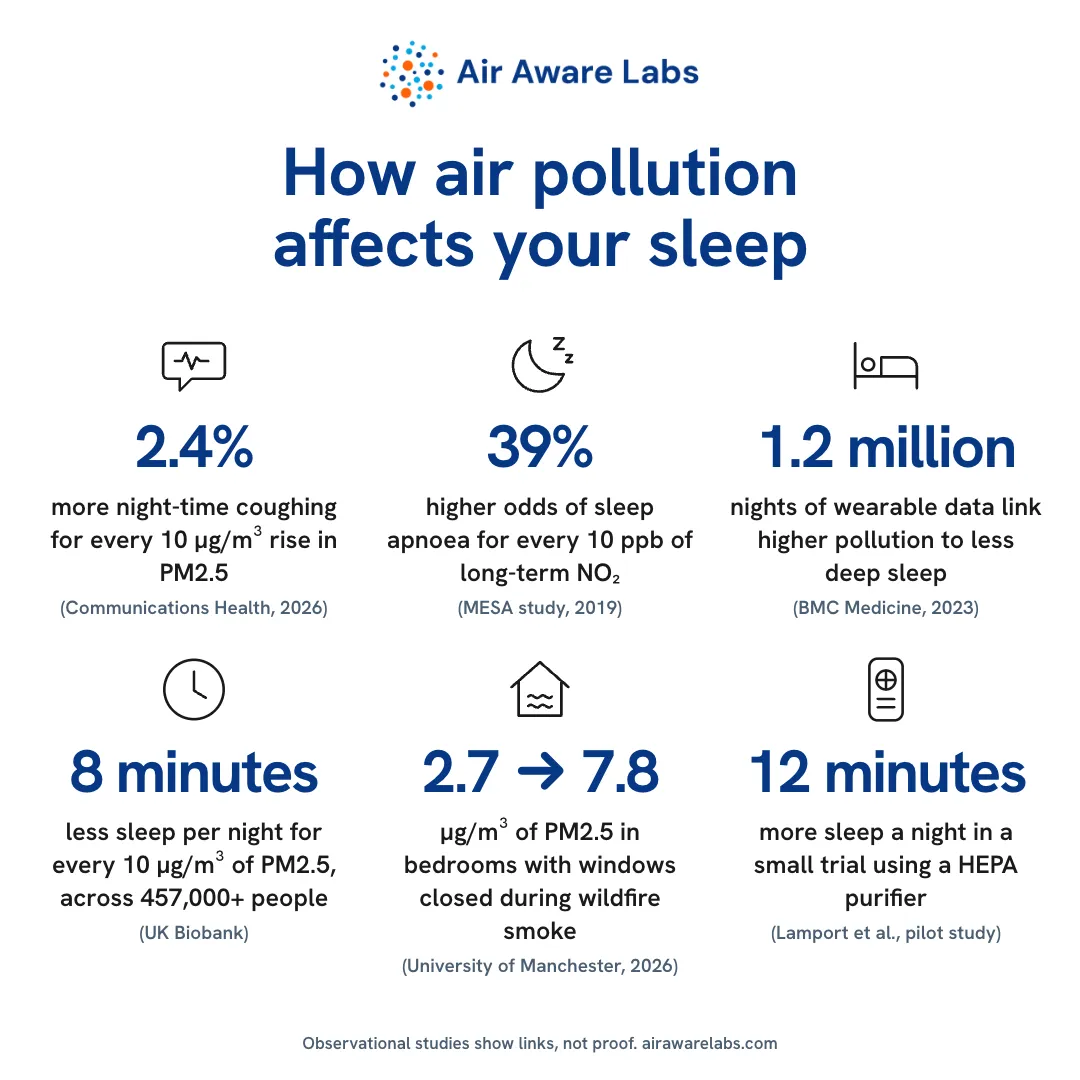
The pattern was clear. The team linked night-time coughing to the air people had been breathing in the days before, measured by outdoor monitors across each city rather than in bedrooms. For every 10 µg/m³ rise in fine particulate matter (PM2.5), night-time coughing went up by 2.4%. Los Angeles gave the team a natural experiment: coughing spiked at the same time as the January 2025 wildfires. And the link held even on days when pollution stayed below the WHO's daily guideline of 15 µg/m³.
It's an observational study, so it shows a link rather than proving cause. But the authors point out that we cough less during deep sleep, so the true effect may be larger than the one they measured. Coughing is an early, everyday symptom, exactly the kind of effect that studies built around hospital admissions and deaths tend to miss. Professor Cecilia Mascolo, who led the work, says the results hint that no level of pollution is entirely safe to breathe, while stressing that the research is observational. The study is published in Communications Health.
It's not just coughing
Cough isn't the only way air pollution could reach your sleep. Studies from around the world point to a few others.
Breathing during the night is one. In the US-based MESA study of 1,974 adults with an average age of 68, people exposed to more nitrogen dioxide (NO₂) and PM2.5 over the long term had higher odds of sleep apnoea, where breathing repeatedly pauses during sleep. The odds were 39% higher for every 10 ppb of NO₂, and 60% higher for every 5 µg/m³ of PM2.5 (a borderline result statistically). The researchers couldn't account for noise and light, and found no link with overall sleep efficiency.
Deep sleep is another. A study of more than 1.2 million nights recorded by wearable devices in China found that higher pollution was linked to longer total sleep but less deep sleep, the stage most associated with restoration. The authors suggest that this could mean more time asleep, but not necessarily better sleep.
How long we sleep is less clear-cut. In the UK Biobank, higher PM2.5 and particulate matter (PM10) were linked to slightly shorter sleep, by around 8 and 7 minutes for every 10 µg/m³, across more than 457,000 people. A California study of 51,562 women found around 6% higher odds of sleeping under seven hours for every 5 µg/m³ of PM2.5. And a 2025 review in Sleep Medicine Reviews concluded that air pollution has a negative effect on sleep in middle-aged and older adults.
What we don't know yet
These are all observational studies, so they show links, not proof. Noise, light, heat and pollution often travel together, and each one affects sleep. Most studies rely on outdoor monitors rather than measurements in the bedroom itself, and wearables tend to overestimate how long we sleep. Researchers are still working out how pollution might disturb sleep, with airway inflammation and changes to the nervous system the main suggestions so far.
The picture for breathing problems and deep sleep is fairly consistent. For total sleep time it's mixed. That should get clearer as more data comes in from sleep trackers and bedroom sensors.
The air in your bedroom
The air you sleep in isn't the same as the air outside, and the difference cuts both ways. In a Danish study of 40 bedrooms, sleeping with the windows open improved bedroom air quality, and people slept longer and rated their sleep better, although NO₂ was slightly higher. With windows and doors closed, CO₂ built up to around 1,800 ppm overnight, which was linked to poorer mental performance the next day.
When the air outside is bad, though, it finds its way in. During the July 2026 Pennine wildfires, University of Manchester researchers monitored 23 homes across Greater Manchester. Overnight bedroom PM2.5 averaged 7.8 µg/m³ with windows closed and 11.8 with windows open, up from a normal 2.7, and some bedrooms went well past 100. Closing windows helped, but it didn't keep the smoke out entirely.
Cleaning the air may help too, although the evidence is early. In a small randomised crossover trial of 30 healthy adults, using a HEPA air purifier was linked to around 12 more minutes of sleep a night than a placebo filter. Several other measures didn't change, and time awake after falling asleep was actually higher. It was a pilot study commissioned by the manufacturer, Dyson, so it's an encouraging signal rather than a verdict.
Small changes for better nights
There's no need to lie awake worrying about this. The bedroom is one of the easiest places to make a difference, and most of the changes are small.
Start with the window. Open it when the air outside is clean and traffic is light, and keep it shut during smoke or pollution spikes. That way you get the fresh air without letting the worst of the outdoors in. A quick check of the air outside before bed is an easy habit to build.
If you have the choice, sleep at the back of the house. Pavements next to busy roads can have 1.5 to 7 times more pollution than quieter streets nearby, so a bedroom facing away from the traffic is a good bet.
Live near a busy road, or somewhere prone to smoke? A HEPA air purifier may be worth trying, and check how loud it is before you buy, as a noisy fan won't help you sleep. And if you have asthma or COPD and notice more coughing at night on polluted days, mention it to your GP or asthma nurse.
See your air with AirTrack
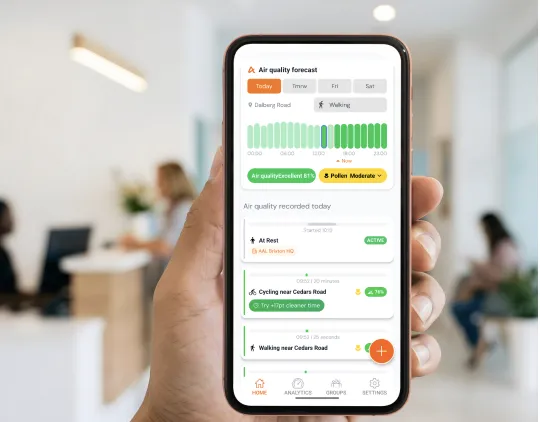
The research is a reminder that the air outside becomes the air inside. AirTrack gives you real-time, location-specific air quality, with the pollutants and pollen behind each reading, so you can decide when to air the room, when to keep the windows shut, and which route to take on your evening walk. It connects with Strava, Apple Health, Google Health Connect and Garmin, so you can see the air behind your activities too.